13-th IEEE/ACM DS-RT 2009
Keynote Speakers
In addition to scientific papers, the DS-RT 2009 program includes two distinguished Keynote Speakers.
Date: Monday October 26, 2009, 9:15 - 10:15 am
Keynote title: Switching to High Gear: Opportunities for Grand-scale Real-time Parallel Simulations
Dr. Kalyan Perumalla
Oak Ridge National Laboratory (ORNL)
TN, USA
Keynote abstract: The recent emergence of dramatically large computational power, spanning desktops with multi-core processors and multiple graphics cards to supercomputers with 10^5 processor cores, has suddenly resulted in simulation-based solutions trailing behind in the ability to fully tap the new computational capacity. Here, we motivate the need for switching parallel simulation research to a higher gear to exploit the new, immense levels of computational power. The potential for grand-scale real-time solutions is illustrated using preliminary results from prototypes in four example application areas: (a) state- or regional-scale vehicular mobility modeling, (b) very large-scale epidemic modeling, (c) modeling the propagation of wireless network signals in very large, cluttered terrains, and, (d) country-or world-scale social behavioral modeling. We believe the stage is perfectly poised for the parallel/distributed simulation community to envision and formulate similar grand-scale, real-time simulation-based solutions in many application areas.
Short Bio: Dr. Kalyan Perumalla is a senior researcher in the Computational Sciences and Engineering Division at the Oak Ridge National Laboratory (ORNL), and holds an adjunct professor appointment at the Georgia Institute of Technology (Georgia Tech). His areas of interest include high performance computing, parallel simulation, and parallel combinatorial optimization. He has co-authored a book, three book chapters, and over 70 articles in these areas in peer-reviewed conferences and journals. Four of his co-authored papers received the best paper awards, in 1999, 2002, 2005 and 2008. He serves on the editorial boards of ACM TOMACS and SCS SIMULATION. He also serves as reviewer with several conferences and journals, and on committees, including as program committee member of Supercomputing 2008, as program co-chair of the 21st IEEE/ACM PADS international workshop (2007), and as chair of the IEEE/ACM Symposium on Asynchronous Methods in Scientific and Mathematical Computing (2007). Several of his research prototype tools have been disseminated to research institutions worldwide. He earned his Ph.D. in Computer Science from Georgia Tech in 1999. He has performed research as an investigator on several federally funded projects, including DARPA, DHS and NSF programs.
Date: Tuesday October 27, 2009, 9:00 - 10:00 am
Keynote title: Latency and User Performance in Virtual Environments and Augmented Reality
Dr. Stephen R. Ellis
NASA Ames Research Center
Moffett Field, CA 94035, USA
Keynote abstract: System rendering latency has been recognized by senior researchers, such as Professor Fredrick Brooks of UNC (Turing Award 1999), as a major factor limiting the realism and utility of head-referenced display systems. Latency has been shown to reduce the user’s sense of immersion within a virtual environment, to disturb user interaction with virtual objects, and to contribute to motion sickness during some simulation tasks.
Latency, however, is not just an issue for external display systems since finite nerve conduction rates and variation in transduction times in the human body’s sensors also pose problems for latency management within the nervous system. Some of the phenomena arising from the brain’s handling of sensory asynchrony due to latency will be discussed as a prelude to consideration of the effects of latency in interactive displays.
The causes and consequences of the erroneous movement that appears in displays due to latency will be illustrated with examples of the user performance impact provided by several experiments. These experiments will review the generality of user sensitivity to latency when users judge either object or environment stability. Hardware and signal processing countermeasures will also be discussed. In particular the tuning of a simple extrapolative predictive filter not using a dynamic movement model will be presented. Results show that it is possible to adjust this filter so that the appearance of some latencies may be hidden without the introduction of perceptual artifacts such as overshoot.
Several examples of the effects of user performance will be illustrated by three-dimensional tracking and tracing tasks executed in virtual environments. These experiments demonstrate classic phenomena known from work on manual control and show the need for very responsive systems if they are intended to support precise manipulation.
The practical benefits of removing interfering latencies from interactive systems will be emphasized with some classic final examples from surgical telerobotics and human-computer interaction.
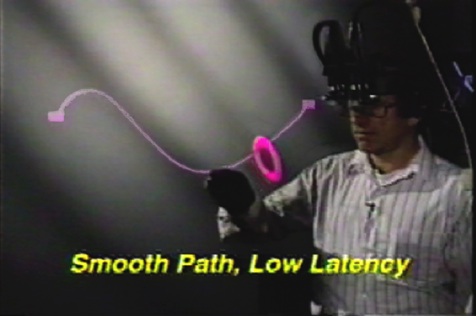
Figure 1. Subject passes a virtual ring over a virtual path while completion time and number of ring-path contacts are studied as a function of system latency.
Short Bio: Stephen R. Ellis headed the Advanced Displays and Spatial Perception Laboratory at the NASA Ames Research Center between September 1989 and March, 2006 and is currently a member of this group. He received a Ph.D. (1974) from McGill University in Psychology after receiving a BA in Behavioral Science from U.C. Berkeley. He has had postdoctoral fellowships in Physiological Optics at Brown University and at U.C. Berkeley. He has published on the topic of presentation and user interaction with spatial information in 170 journal publications and formal reports and has been in the forefront of the introduction of perspective and 3D displays into aerospace user interfaces. Most recently, he has worked on kinesthetic techniques to improve cursor and manipulator control under difficult display control coordinate mappings. He has served on the editorial boards of Presence, Human Factors and Virtual Reality and has edited a book, “Pictorial communication in virtual and real environments”, concerning the geometric and dynamic aspects of human interface to systems using spatial data.(Taylor and Francis, London, 2nd Ed. 1993).